By Alex Ehrlich, Rare Minerals Earth
In May 1834, a Russian official sent several unusual crystals from the emerald mines of the Urals to a mineralogist for examination. He also made a point of asking for two from his own collection back.
That detail made me smile. Nearly two hundred years have passed, and I can still recognise the collector in that letter. By all means investigate the interesting mineral. Just remember which pieces belong to me.
The official was Lev Perovskii, writing to Nils Gustaf Nordenskiöld. In correspondence reproduced in a 2021 archival study, he described flattened, intersecting crystals and a change from green to red under different lighting. He also noticed that red could appear in parts of a stone even in daylight.
We now know the material as alexandrite, usually introduced with the phrase “emerald by day, ruby by night”. It is a memorable description, and fine stones can certainly live up to the excitement behind it. But it leaves rather a lot out.
The royal story is usually tidier as well, placing alexandrite’s discovery on the future Tsar Alexander II’s birthday in 1834. The 2021 archival study instead traced the first finds to 1833 and the naming to 1842. It also restored attention to Yakov Kokovin, who supervised the emerald workings and recognised the unusual material. The individual miners who first found it remain unidentified.
That bothers me slightly. We have remembered the prince well enough to put his name on every label, while the people who recovered the crystals have disappeared from the account. Kokovin deserves more credit too. He recognised that some of the material coming out of the emerald workings needed further investigation.
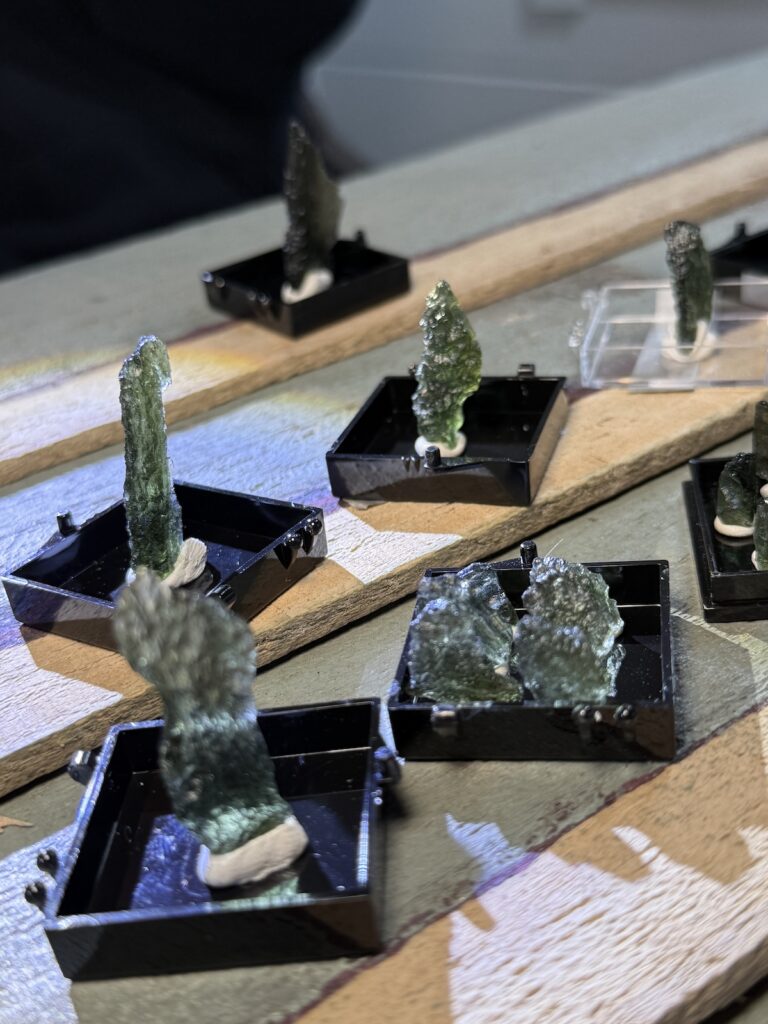
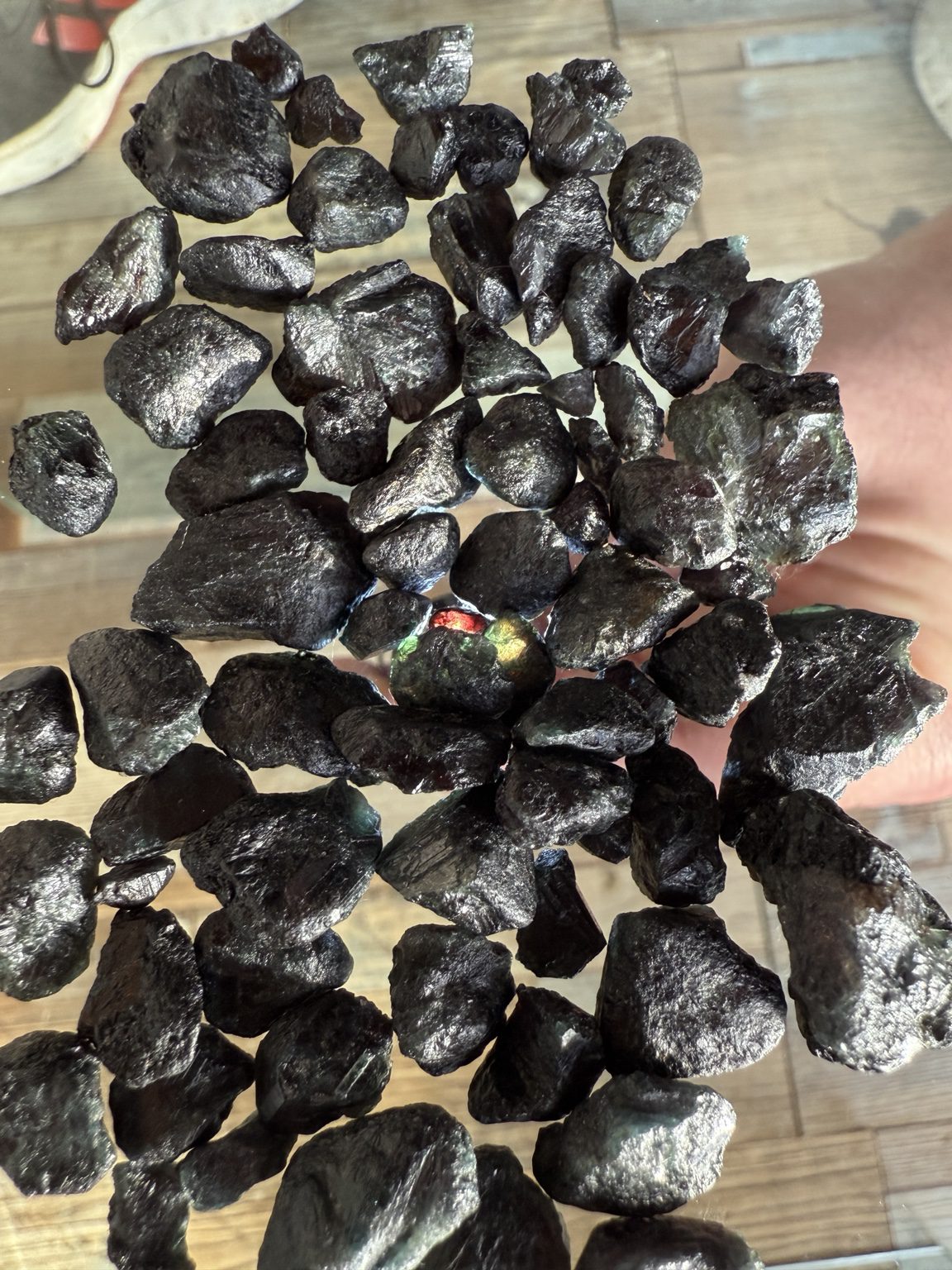
Spread my own specimens across a tray and you would not immediately think of a jeweller’s window. Much of the material looks dark green, almost black in the thicker parts, with bright reflections coming off the surfaces. Some pieces are broad and flattened. Others are smaller and more angular, and a few have outlines that spread into several lobes. There are ridges and lines running across the faces, sometimes clearer to see than the colour itself.
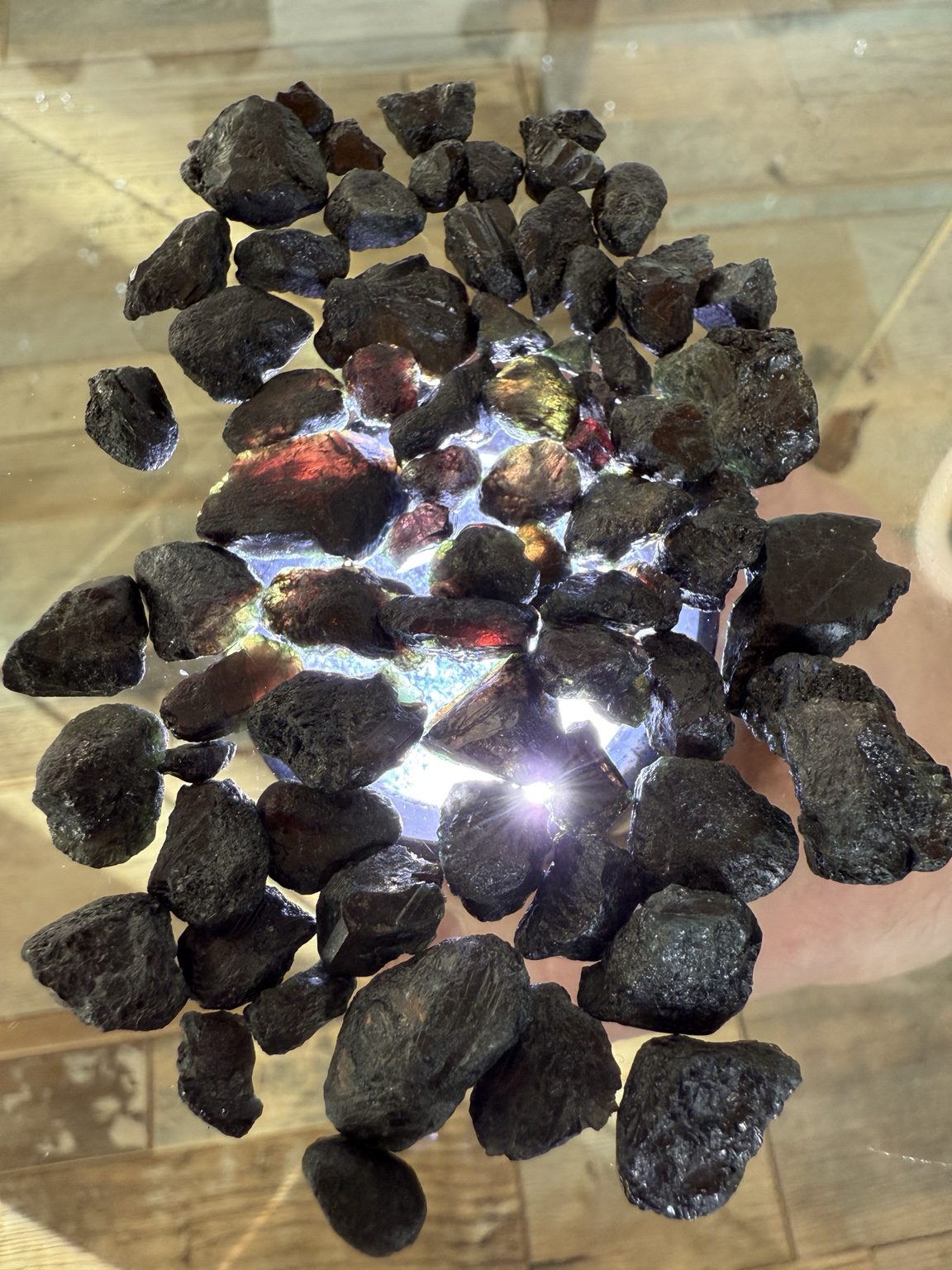
Put light behind them and the tray becomes much more interesting. Green appears along a thin margin. A wine-red patch shows through another piece. Much of the surrounding crystal can remain dark, so the colour appears in quite small areas rather than lighting up the whole specimen.
I can see why somebody expecting two bright, transparent gemstones in one might be puzzled. My attention goes to the broad faces and the uneven outlines as well. I want to know why one crystal has grown outwards while another is compact, and why the lines on a surface change direction where they do. Once I have several together, comparing them can occupy me for rather longer than sorting a tray ought to take.
My material comes from Serra da Carnaíba de Cima and Serra da Carnaíba de Baixo in Bahia, Brazil. While researching the locality, I found a brief passage in a 1988 Gems & Gemology article that felt particularly relevant.
The author, Keith Proctor, described much of the alexandrite produced at the Carnaíba emerald mine as low quality, but also singled out its “superb sixling crystals”.
Much of the attention given to alexandrite concerns its potential as a gemstone. Transparency matters enormously there, as do the strength and attractiveness of the colour change. A dark or heavily included crystal may offer little to somebody hoping to cut a clear, bright stone.
A mineral collector has other reasons to be interested. The original form can be the very thing they want to preserve.
The sixlings mentioned in that report are twinned growths with an apparently sixfold arrangement. Chrysoberyl, the mineral of which alexandrite is a variety, belongs to the orthorhombic crystal system. It can nevertheless produce shapes that look almost hexagonal when differently oriented crystals grow together in a regular relationship.
Twinning is worth looking for in material from this locality, although an irregular outline alone is not enough to identify a particular twin. With my own pieces, the flattened forms, changes in outline and surface ridges give me something to examine before I have even started comparing the colour.
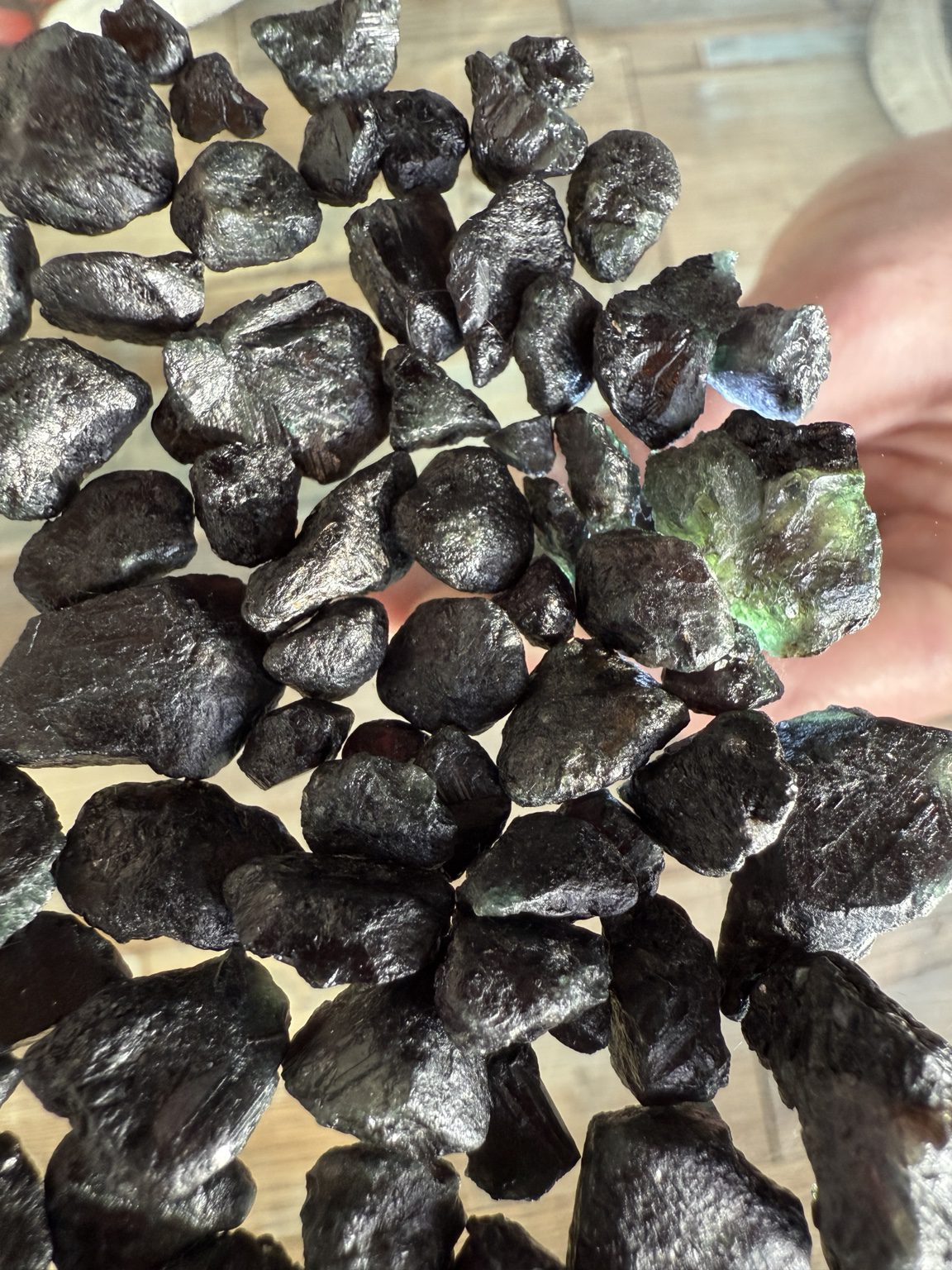
In my photographs and videos, the backlighting reveals colour that is difficult to see from above. Demonstrating alexandrite’s characteristic colour change means comparing the same specimen under different kinds of illumination, classically daylight and incandescent light. Green showing through one piece and red through another does not establish that change by itself.
I would rather explain that properly than leave somebody wondering why their crystal does not behave like a pair of photographs they saw online.
Alexandrite is a beryllium aluminium oxide containing small amounts of chromium. The chromium affects which wavelengths of light the crystal absorbs, leaving stronger transmission in the blue-green and red parts of the spectrum. Daylight and incandescent light supply those wavelengths in different proportions, which helps the same stone appear green under one and reddish under the other.
There is another complication because chrysoberyl is pleochroic: its colour can also differ with the direction from which you look through it. Turning a specimen and changing the light source are therefore doing different things, even though both can alter what you see.
Given how much trouble I have photographing minerals, I am almost relieved that alexandrite has a reasonable excuse. Between the illumination, the direction of view and the amount of crystal the light has to travel through, one photograph has quite a job on its hands.
Brazil is an important part of alexandrite’s story, but the mineral also occurs in Sri Lanka, India, Tanzania, Madagascar and Zimbabwe, among other countries. Russia gave it its name and early reputation; it did not have the only geology capable of producing it.
Nor does a country name tell us how a crystal reached the person who found it. In the Urals, alexandrite occurs in mica-rich rocks associated with emerald deposits. In Sri Lanka, it is recovered from gem-bearing gravels, after weathering and erosion have removed it from its original surroundings. Tanzania has both occurrences in host rock around Lake Manyara and alluvial material at Tunduru.
A crystal recovered from gravel has already survived the destruction of the rock around it and movement through the landscape. One extracted from its host rock may still retain something of the place where it grew.
Even “Brazilian alexandrite” needs narrowing down. The famous Hematita discovery of 1987 was in Minas Gerais. My Carnaíba material comes from Bahia. Both belong in the Brazilian story, but I would not use the reputation of one deposit as a description of the other.
What struck me about Perovskii’s letter was how closely he had looked at the crystals. He described their flattened shapes and recorded red appearing in daylight, an observation that gets lost in the usual description of alexandrite.
Those are the details I find myself examining in my own material in Cheshire. The bright green margin gets my attention. Then I notice the ridges across the face, turn the piece over and start comparing it with the one beside it.
“Emerald by day, ruby by night” might persuade somebody to look at alexandrite. It does very little to explain why a particular rough crystal becomes the one they want to keep.
Perovskii had already decided which specimens he wanted back before the mineral even had its name.
I understand why he wanted them back.
You can browse alexandrite specimens at Rare Minerals Earth.