I thought I knew what salt looked like.
I live in Northwich, a town whose history and landscape have been shaped by salt. There are buildings designed around subsidence, lakes formed where old workings collapsed and an entire local identity built around what lies beneath our feet. So I thought I had a fairly good idea of what salt looked like.
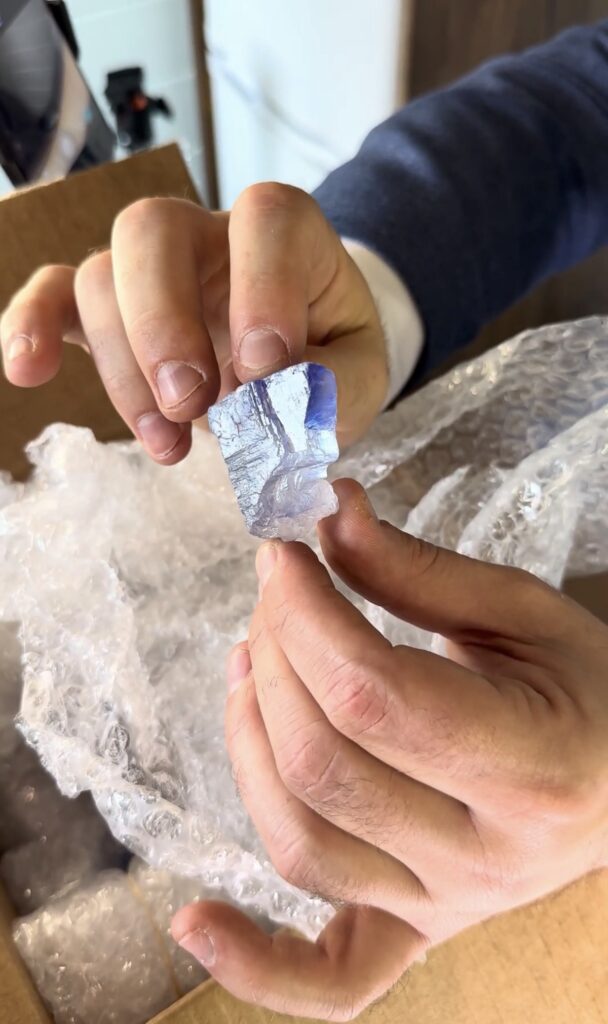
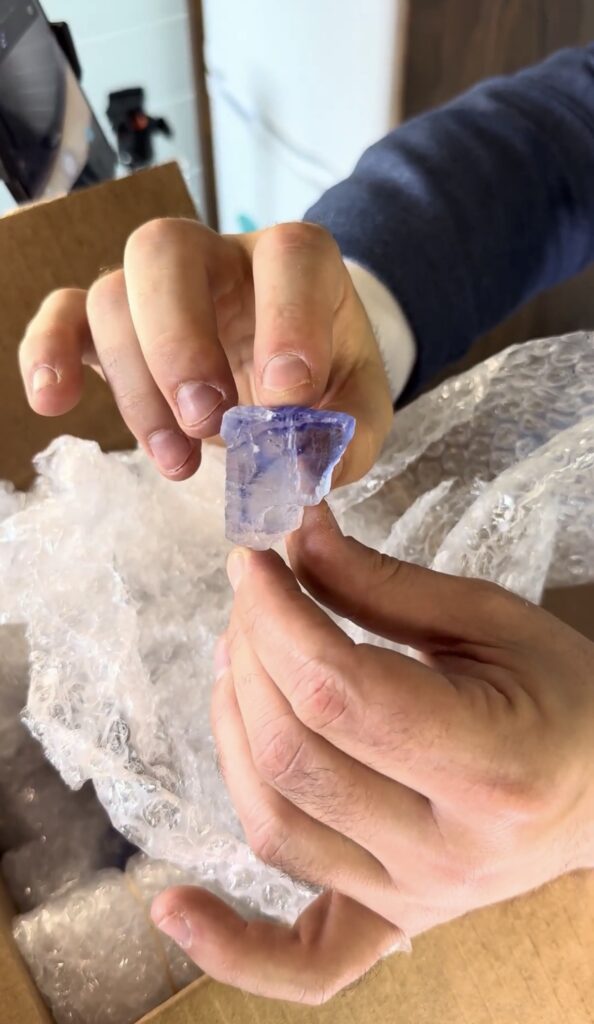
Then I opened a box of blue halite from Iğdır Province in eastern Turkey.
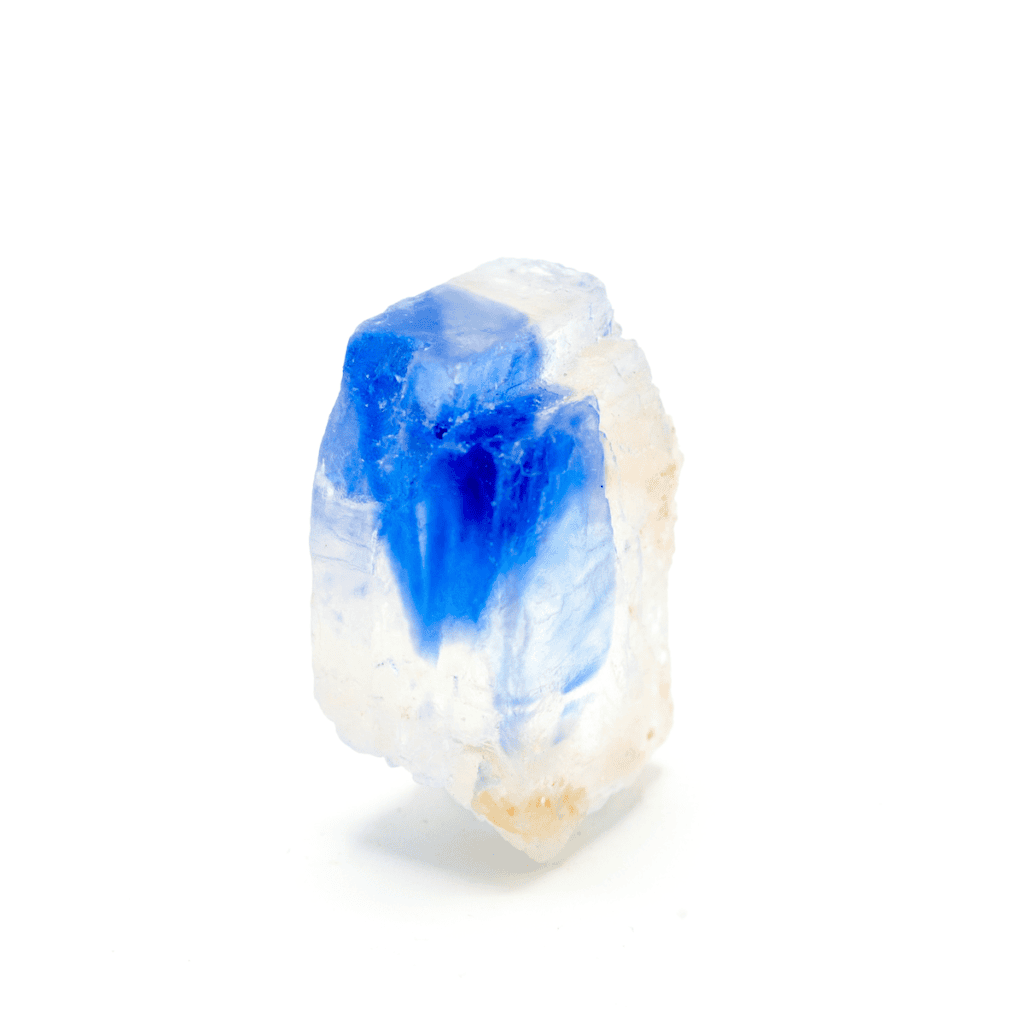
Some pieces were almost transparent. Others held a deep blue that seemed to sit inside the crystal rather than on its surface. The edges were sharp, the faces remarkably flat. They looked more like fragments of frozen ocean than anything I would associate with a salt cellar.
And yet this was salt.
Halite is the natural mineral form of sodium chloride. Table salt is usually refined, crushed and reduced to millions of small white grains. A halite specimen allows you to see what the same chemistry can create underground, before its natural form is lost through processing.
That was the first thing that caught me. Something we barely notice at the dinner table is capable of growing into a genuine crystal.
My specimens were sourced from Iğdır Province, close to Turkey’s border with Armenia. The recognised halite locality in the province is Tuzluca, a place so closely connected with salt that its name comes from tuz, the Turkish word for salt. Halite and gypsum are both recorded there, and commercial salt deposits occur in the Tuzluca Formation, with a number of mines east of the town.
Salt is not just something removed from the ground there. It is part of the identity of the place.
The deposits formed during the Miocene, when shallow saline lakes or salt pans repeatedly concentrated and dried out. The water disappeared, but the dissolved minerals did not. Salt and gypsum accumulated in layers, were buried and remained while the world above them continued to change. The beds themselves are millions of years old, although an individual crystal may have dissolved and grown again later as water moved through the deposit.
I keep coming back to the vanished water.
A lake existed in a landscape none of us would recognise. It evaporated so completely that the lake itself disappeared, but part of it stayed behind as mineral. Seasons passed. Species came and went. Human beings eventually arrived, drew borders across the land and gave the area a name that literally meant salt.
Then somebody entered the old deposit and found a blue cube.
The shape is not something the crystal added at the end. It begins with sodium and chloride ions arranging themselves into a repeating atomic structure. That order is far too small for us to see, but it continues as the mineral grows until the hidden pattern becomes a cube we can hold.
In other words, the cube was already there inside the chemistry.
Nobody drew it or checked whether the corners were straight. Nature followed rules that existed long before there was a human mind capable of understanding them.
Then there is the blue.
Pure halite is usually colourless or white. Research into naturally blue halite has found that its vivid colour can be produced by metallic sodium particles inside the mineral, measuring only around 2.5 to 3 nanometres across. A nanometre is one billionth of a metre.
I am not sure our minds are particularly good at imagining something that small. Yet particles thousands of times narrower than a human hair can alter the way an entire crystal interacts with light.
A change we cannot see creates the feature nobody can ignore.
I like that about blue halite. We spend so much time trying to make things flawless and uniform, yet its most memorable feature comes from something happening inside the crystal that interrupts its ordinary structure. Without that disruption, it might have remained clear and passed unnoticed.
Salt itself has rarely passed unnoticed in human history. Before refrigeration, it helped preserve food and allowed supplies to last longer. Communities traded it, authorities taxed it and routes developed around moving it from one place to another. The Roman Via Salaria was closely associated with the salt trade, and the Latin salarium eventually gave us the word “salary”. The popular story that Roman soldiers were literally paid in blocks of salt is doubtful, but it survives because salt genuinely was tied to survival and value.
We still call somebody “worth their salt”.
Salt also found its way into belief. It has been placed at thresholds, used in purification and thrown over the shoulder after being spilled. Some people understand those traditions spiritually. Others see practical knowledge that slowly gathered symbolism. Salt preserved food, drew out moisture and slowed decay, so it is not difficult to understand why people began associating it with protection.
I do not need to claim that blue halite possesses supernatural powers. I find the reality more than strange enough.
When I select these specimens, I look at how the blue moves through the crystal, whether light can reach its interior and how clearly the cubic shape remains visible. Halite is soft, brittle and soluble in water, so a sharp specimen has already survived more than its heavy, solid appearance suggests.
But all of that comes after the first response.
How can that possibly be salt?
I grew up in a town where salt is part of the landscape, and blue halite still made me feel as though I had never really seen it before.
A lake disappeared millions of years ago. Its salt remained. Invisible atomic order created a cube, then particles only a few billionths of a metre wide turned it blue.
How many other things has the Earth made astonishing, only for us to stop noticing because we thought we already understood them?